 Indian Industry Plus A Pratisrutiplus Suppliment





Researchers have made a significant breakthrough in understanding how small organic molecules can be guided to form advanced functional materials. This could facilitate future electronic devices, tuneable optoelectronic systems, responsive materials, and bioelectronic interfaces.
The team from the Centre for Nano and Soft Matter Sciences (CeNS), Bengaluru, in collaboration with the Jawaharlal Nehru Centre for Advanced Scientific Research (JNCASR), both autonomous bodies under the Department of Science and Technology (DST), Government of India, investigated naphthalene diimide (NDI), which is amphiphilic molecule with the unique ability to organize itself in water through a process known as supramolecular self-assembly.
Amphiphilic molecules come together through noncovalent interactions and form well-defined nanostructures. Such assemblies that can be controlled are crucial for emerging applications in electronics, photonics, and biomedical devices.
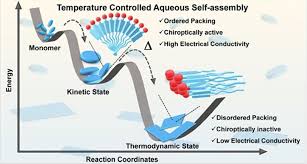
The researchers discovered that at room temperature, these molecules self-assemble into tiny circular nanostructures called nanodisks. These nanodisks display an optical property that enables them to interact with polarized light in a distinctive way (chiroptical activity).
Upon heating, the nanodisks are structurally reorganised and transform into two-dimensional nanosheets that lose their chiroptical activity. This shows that temperature alone can switch the material between different structural and optical states.
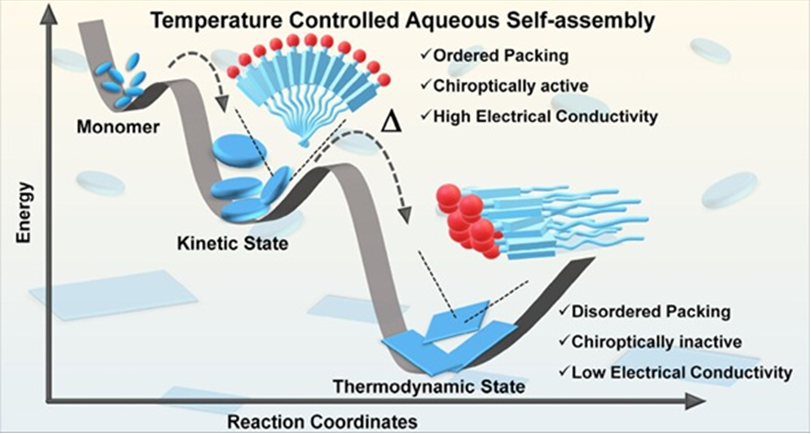
The team also observed that the nanodisks showed significantly higher electrical conductivity, which decreased nearly sevenfold when they converted into nanosheets. This demonstrates that the electrical behaviour of the material can be precisely tuned by controlling its self-assembly pathway. Such tunability is a rarity in small organic molecules.
This ability to dynamically adjust structural, optical, and electrical properties using temperature provides a powerful route to developing smart, adaptive materials.
The study, recently published in ACS Applied Nano Materials by the American Chemical Society, highlights how understanding nanoscale molecular behavior can influence the design of next-generation functional materials. By showcasing a simple yet effective method to control molecular assembly, the work opens new avenues for designing advanced materials for sensors, electronics, and smart technologies.
The research led by Dr. Goutam Ghosh (CeNS), along with his PhD student Mr. Sourav Moyra (CeNS) and collaborator Mr. Tarak Nath Das (JNCASR) provides valuable insights into using supramolecular chemistry to engineer highly tunable and efficient smart materials.