 Indian Industry Plus A Pratisrutiplus Suppliment





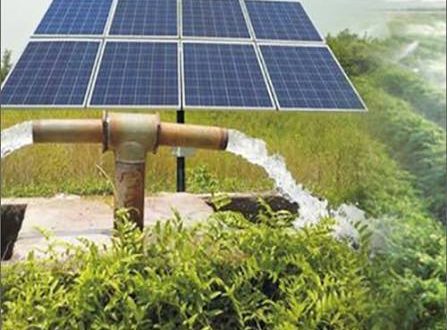
Solar pump sets operate with lower cost as source of energy is sunlight; which is entirely free. Farmers can go for multiple cycle of crops or for long duration horticultural plants to get more productivity and profit. Hence, the combination of solar power and farming is not only replacing the conventional farming rather it complements each other.
The Kisan Urja Suraksha evam Utthaan Mahabhiyan (PM- KUSUM Scheme) of the Government of India is an innovative model for farmers to earn more from less drops of water. This is suitable for farm lands lacking in electricity power and also from irrigation facility forcing farmers either to leave the field barren or raise a low yielding crop. A borewell integrated with a solar generating system which is fitted with a pump set prompts the farmers to harvest high value crops and make the project a profitable one. Both the central and the state government are providing substantial amount towards central and state subsidies separately for promoting such projects. This model of having solar power system integrated with farming activities is popularly known as “Agrivoltaics”. Using agricultural land for food production as well as for solar power generation is making this model a unique one.
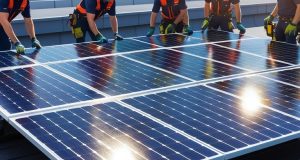
This integrated project comprises of solar photovoltaic panels, water source (borewell), water lifting devices (pump set) and a drip irrigation system. Required numbers of Solar Photovoltaic panels are installed to convert solar energy into electricity which can be used for running the pump set. The additional energy produced, if any, can be reverted back to grid system and generate revenue for the farmers. Safety measures are taken through additional components like earthing, lightning conductor, invertor (converting DC current to AC) and other electrical accessories. Combining solar power with agricultural farming seems to be a practical approach in using farm land for both food production and energy generation.
Access to energy should always be converted into efficient water use. Pump set with desired capacity (usually 3 to 5 Horse Power) can be installed based on selection factors like land size, type of crop and availability of water in bore well. Crops with high value and low water requirement should always be preferred to earn ‘more crop per drop’ of water. A drip irrigation system is preferred for high value spacing crops (having market access) to save water and cost of irrigation. The coverage area will be more by avoiding flood irrigation while considering low water generating source and higher cost of project. Drip irrigation system is a network of pipes with required number of drips connected to it in order to discharge droplets of water in the root zone of the plant. Thus, it is a precision irrigation method by which water can be used more efficiently using renewable energy to reap high value crop and to earn more in comparison to traditional farming method. Even farmers are dovetailing horticulture techniques like greenhouse infrastructure and getting additional subsidy separately for it.
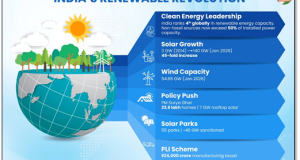
The Government of India have an ambitious target for use of green and clean energy through solar power and have taken several initiatives through various schemes like PM-KUSUM (as explained above) and Atal Jyoti Yojana providing substantial subsidy to encourage component manufacturers, investors and farmers. Some state Governments are also offering additional subsidy to boost the programme. For example, Rajasthan Government is encouraging farmers to install solar pump sets by providing subsidy up to 60 per cent of the total cost. It also provides additional subsidy of Rs 45000 to scheduled caste and 100 percent subsidy to tribal farmers. The capacity of solar energy in India has grown at a rate of 40% per year since 2015 and reaching an installed capacity of 168.04 GW by August 2026.
Few other states are also promoting micro-irrigation method combining with solar powered pump set to save depleting ground water and encouraging commercial spacing crops. As per an estimate, irrigation through drip method saves 3000 cubic meters of water per hectare annually as compared to traditional flood irrigation. Solar pumpsets operate with lower cost as energy source (sunlight) is entirely free. Farmers can go for multiple cycle of crops or for long duration horticultural plants to get more productivity and profit. Hence, the combination of solar power and farming is not only replacing the conventional farming rather it complements each other.
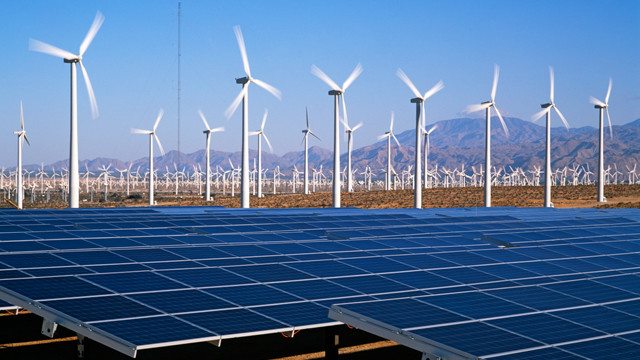
With the advancement of technology, it is expected that both solar powered irrigation and hybrid land-use system will be able to change the farming landscape in rural India. The solar capacity and the applications in India have been increasing in India in the recent years with increase in investor interest in renewables and with increasing confidence of the users in the solar energy.