 Indian Industry Plus A Pratisrutiplus Suppliment





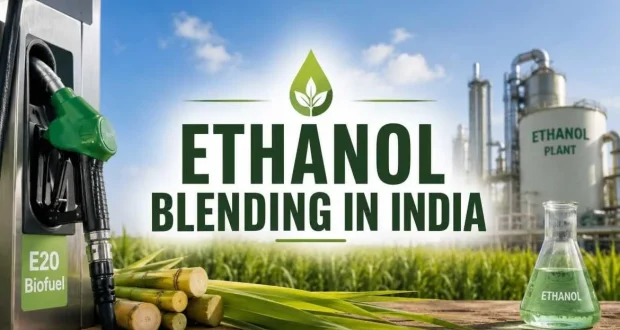
India scaled its ethanol blending rate from under 1.5 percent in 2013–14 to 20 percent in Ethanol Supply Year (ESY) 2025–26, advancing its original 2030 deadline. Starting April 1, 2026, E20 became the mandatory standard fuel sold across retail pumps nationwide, carrying a minimum Research Octane Number (RON) of 95.
India’s Ethanol Blended Petrol (EBP) programme has achieved its landmark 20 percent blending target (E20) five years ahead of schedule in 2025–26, yet the rapid transition has sparked intense national debate over fuel quality, vehicle compatibility, consumer transparency, and agricultural resource strain. While the Union government highlights massive foreign exchange savings and rural income gains, recent state-level laboratory investigations, motorist complaints, and abrupt feedstock policy reversals have exposed major operational and regulatory friction.
India scaled its ethanol blending rate from under 1.5 percent in 2013–14 to 20 percent in Ethanol Supply Year (ESY) 2025–26, advancing its original 2030 deadline. Starting April 1, 2026, E20 became the mandatory standard fuel sold across retail pumps nationwide, carrying a minimum Research Octane Number (RON) of 95. According to official data from the Press Information Bureau, domestic ethanol production capacity expanded nearly fivefold from 421 crore litres in 2014 to roughly 2,000 crore litres by 2026. During ESY 2025–26 (which ended October 31, 2026), public sector Oil Marketing Companies (OMCs) blended 1,134 crore litres of ethanol against petrol sales of roughly 5,673 crore litres. The Union government reports that the programme has substituted 316 lakh metric tonnes of imported crude oil, saved ₹1.97 lakh crore in foreign exchange, reduced carbon dioxide emissions by 952 lakh metric tonnes, and transferred ₹1.66 lakh crore to farmers.
In early November 2026, the programme faced a major credibility test after the Karnataka government released findings from third-party laboratory tests conducted at the NABL-accredited Shriram Research Institute. State Food and Civil Supplies Minister Rizwan Arshad and Chief Minister D.K. Shivakumar stated that fuel samples collected across 63 to 67 locations showed widespread over-blending beyond the 20 percent statutory cap, with samples from Indian Oil Corporation reaching 31.2 percent and Hindustan Petroleum Corporation touching 30.5 percent. Following Karnataka’s findings, the Kerala government also ordered statewide inspections at 20 retail sites. Opposition leaders accused the Centre of penalizing motorists with degraded fuel without price relief, while the Karnataka government demanded mandatory pump-level blend displays and a consumer compensation fund. Public sector OMCs strongly refuted the allegations, stating that 893 samples tested across 27 states and union territories under prescribed Bureau of Indian Standards (BIS) protocols remained strictly within the 19 to 21 percent range, and arguing that commercial over-blending would be financially counterproductive for oil firms.
Because ethanol has a lower calorific value and energy density than pure petrol, higher blends naturally reduce fuel economy. The Union government acknowledges a 3 to 5 percent mileage drop in older vehicles calibrated for E10 fuel, though industry surveys; such as a July 2026 Local Circles poll of 22,000 car owners found that 60 percent of motorists reported mileage declines exceeding 10 percent. While vehicles manufactured in India after April 2023 are E20 material-compliant and post-April 2025 models are fully E20 engine-tuned, tens of millions of legacy BS-III and BS-IV vehicles remain on the road. Road Transport Minister Nitin Gadkari noted in Parliament in July 2026 that pre-2016 BS-III vehicles may require periodic replacement of rubber hoses and gaskets. Conversely, at a joint press conference convened by central ministries in July 2026, major automakers including Maruti Suzuki, Hero MotoCorp, and Toyota Kirloskar cited service data from over 2.84 crore vehicles to assert that E20 causes no abnormal engine wear or corrosion. However, consumers continue to criticize the absence of E0 or E10 fuel options at retail pumps and the lack of price pass-through despite ethanol costing less to produce than refined petrol.
Scaling ethanol production to over 1,100 crore litres annually has placed severe pressure on India’s water table and food supply chains. Producing a single litre of sugarcane-derived ethanol requires roughly 2,800 to 3,000 litres of water when accounting for crop irrigation, exacerbating groundwater depletion in major producing belts like Maharashtra and Uttar Pradesh. Furthermore, balancing fuel mandates against domestic food inflation has forced volatile policy reversals. After briefly lifting sugar diversion caps in September 2025 due to a strong monsoon, the Centre abruptly reversed course on October 16, 2026. For the 2026–27 ethanol supply year starting November 2026, the Department of Food and Public Distribution enforced a zero-sugar-diversion policy, barring OMCs from procuring ethanol made from sugarcane juice, sugar syrup, or B-heavy molasses to protect domestic sugar stocks and curb retail food inflation. Consequently, nearly the entire 1,100-crore-litre tender for 2026–27 now relies on grain-based feedstocks; primarily maize, broken rice, and surplus Food Corporation of India rice alongside C-heavy molasses. Simultaneously, the Centre lowered the procurement incentive for maize-based ethanol from ₹71.86 to ₹68.86 per litre, sparking concerns among distillers and agricultural economists about tighter grain competition and feed inflation for the poultry and livestock sectors.
Even as the Centre notified amendments to the Central Motor Vehicles Rules in October 2026 to permit E100 flex-fuel vehicles and research bodies project an E30 roadmap by 2030, Petroleum Minister Hardeep Singh Puri clarified that the government has no immediate plans to raise mandatory retail blending beyond 20 percent. Moving forward, sustaining India’s biofuel transition depends on resolving pump-level testing transparency, protecting legacy vehicle owners, and decoupling ethanol production from water-intensive food crops through second-generation agricultural waste technologies.
Ultimately, the long-term viability of India’s ethanol blending programme hinges on moving beyond headline blending targets to address its deeper structural vulnerabilities. While E20 has proven its macroeconomic worth in trimming crude oil import bills and boosting rural liquidity, its sustainability remains precarious so long as feedstock supplies fluctuate with monsoon vagaries and food inflation fears, forcing abrupt bans on sugar diversion and straining grain markets. True viability requires accelerating second-generation (2G) biofuel technologies that convert agricultural stubble and non-food biomass into fuel, thereby decoupling energy security from groundwater depletion and food security. At the retail end, public trust can only be restored through transparent, independent pump-level quality audits, clear labelling of blend ratios, and either calibrated fuel options or fair price pass-throughs for the millions of legacy motorists absorbing mileage losses. Without aligning ecological limits, agricultural stability, and consumer equity, India risks turning a landmark green energy transition into a recurring cycle of supply shocks and public pushback.