 Indian Industry Plus A Pratisrutiplus Suppliment





India’s trade performance has remained robust and resilient, with exports recording a steady upward trajectory both in the current fiscal year (FY 2025–26, Apr–Jan) and over the longer term (FY 2021–25). Despite persistent global uncertainty, supply chain disruptions, and volatile commodity prices, India’s exports have continued to expand in a broad-based manner. During Apr–Jan of FY 2025–26, total exports of merchandise and services rose by USD 36 billion, registering a growth of 5.26% from USD 679.02 billion in FY 2024–25 (Apr–Jan) to USD 714.73 billion. Over the period 2021–22 to 2024–25, exports achieved a compound annual growth rate of 6.9%, with values increasing sharply from USD 497.90 billion in 2020–21 to USD 828.25 billion in 2024–25. This consistent expansion underscores India’s ability to sustain diversified and resilient export growth, positioning the country as a strong player in global trade even under challenging external conditions.
The Government is consistently working to boost exports and expand the country’s global footprint, combining traditional strengths with emerging technology‑driven sectors. Central to this ambition is the creation of a supportive ecosystem where exporters, particularly MSMEs, can compete confidently in international markets. This effort is reinforced by a dynamic policy framework, strong financial incentives, a growing digital infrastructure, improved trade facilitation, and a determined push to secure deeper market access through next‑generation trade agreements.
The Foreign Trade Policy (FTP) 2023, designed as a flexible and evolving framework to adapt to global shifts, has emerged as a key enabler of India’s export momentum. Built on four core pillars – trade facilitation, export promotion, state‑level partnerships, and digital integration – the FTP is further reinforced by targeted export promotion schemes that collectively enhance India’s competitiveness in global markets.
The RoDTEP scheme plays a central role by neutralizing embedded taxes on exports and enabling Indian goods to remain competitive worldwide. The recently launched Export Promotion Mission (EPM) 2 further reinforces this effort through two targeted pillars: expanding access to affordable trade finance and upgrading quality, logistics, branding, and market‑readiness across the export value chain. The Government has approved the EPM with a budgetary outlay of Rs. 25,060 crores (FY 2025–26 to FY 2030–31). It operates through Niryat Protsahan (focusing on trade finance and credit enhancement) and Niryat Disha (focusing on export logistics, warehousing, and market access), specifically targeting MSME competitiveness.
The Government has recently notified a time-limited “RELIEF” Scheme, an intervention under the Export Promotion Mission, to be implemented through the Export Credit Guarantee Corporation of India (ECGC), is operationalised to address elevated export risks arising from geopolitical disruptions in the Gulf and West Asia maritime corridor.
Together with the Export Credit Guarantee Corporation (ECGC), which provides critical risk‑mitigation support for exports, and schemes like Trade Infrastructure for Export Scheme (TIES) that build export‑linked infrastructure across the country.
Running parallel to these financial and policy instruments is India’s accelerating shift toward technology‑enabled trade governance. A strong digital backbone powered by platforms such as the 24×7 EIC interface, the Trade Intelligence & Analytics platform, the Common Digital Platform for Certificates of Origin, and the Trade e-Connect portal has transformed how exporters access information, approvals, and global markets. These systems enable fully online processing, real‑time compliance updates, digital certification, faster turnaround times, and easier access to global market intelligence. The outcome is a trade ecosystem that is more transparent, data‑driven, efficient, and equitable.
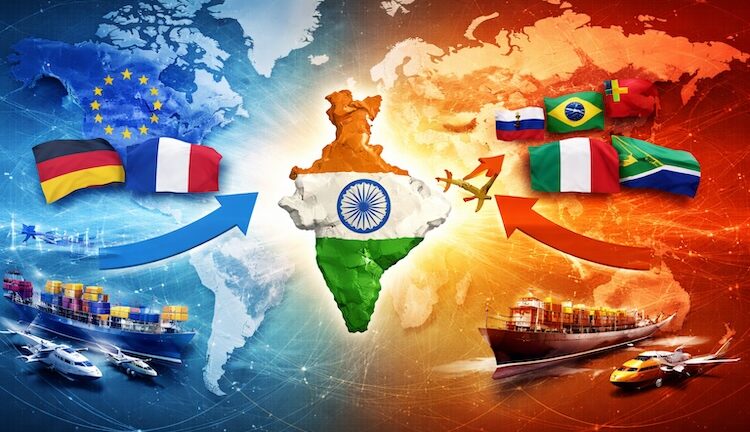
Proactive trade diplomacy complements policy measures and expanding digital infrastructure, reinforcing the country’s efforts to strengthen global market access and enhance export competitiveness. With 19 FTAs and a renewed push since 2021 wherein India has concluded or advanced eight major agreements with key partners. The India-EU FTA, a landmark pact offering access to almost the entire EU tariff universe, marks a significant step in integrating India more deeply into global value chains. The India-EFTA Trade and Economic Partnership Agreement (TEPA) is India’s first FTA to include a dedicated commitment aiming to increase FDI from their investors. Trade agreements with New Zealand, Oman and UK will broaden market access, enhance services mobility, secure long‑term investments, and create predictable regulatory environments for businesses. Meanwhile, ongoing negotiations with Israel, Canada, GCC nations, Chile, and Peru indicate India’s determination to expand high‑value trade corridors across regions.
India’s export strategy reflects a decisive whole‑of‑government approach, moving beyond transactional support to building a resilient, competitive, and future‑ready ecosystem. By combining targeted financial incentives, technology‑enabled trade facilitation, institutional reforms, and proactive market‑access initiatives, the focus is on embedding digital governance, expanding global reach, and strengthening exporter capabilities across sectors and regions. This integrated approach positions India not just as a participant, but as a trusted, technology‑driven partner in global trade.
This information was given by the Minister of State for Ministry of Commerce & Industry, Shri Jitin Prasada, in Lok Sabha today.