 Indian Industry Plus A Pratisrutiplus Suppliment





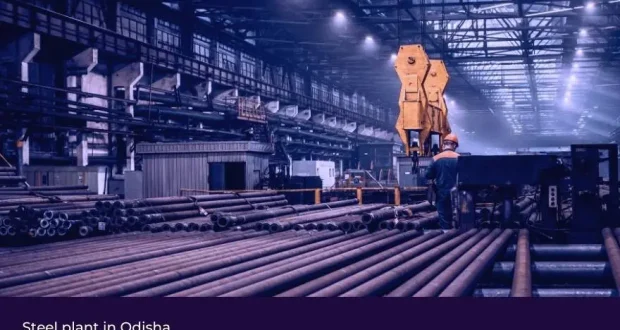
Odisha is rapidly transforming from India’s ‘mineral basket’ into ‘steel capital’ and is powered by the Government’s vision to reach an annual capacity of 130 million tonnes of steel by 2030 accounting for nearly half of national target.
Odisha is an iron ore rich state and is also considered as one of the leading producers of both crude and stainless steel. The state has huge iron ore reserves in its account and also has number of production units hosted by established manufacturers like TATA steel, Steel Authority of India (SAIL), Jindal Steel Works (JSW) and ArcelorMittal.
India has 18,000 million tonnes of iron ore reserves out of which Odisha alone has a share of 35 to 39%. In Odisha, iron ores are rich in haematites and the state is having its richest deposits in Barabil-Koira valley in Keonjhar district. The state produces highest quantity of both crude and stainless-steel in India. The growth and development in the steel sector are crucial for the industrial development in addition to job creation and economic development of all stakeholders.
The per capita steel consumption in India comes around 95-100 kg during 2024-25 financial year as against world average of 219-230 kg. This highlights about the huge growth potential in the country which is driven by growing infrastructure and manufacturing activities. As per National Steel Policy, the per capita steel consumption in India is targeted to reach 160 kg by 2030 FY. India is now the second largest producer of steel (149 million MT) next to China (1005 million MT). While China dominates in quantity of production, India has shown higher growth rate resulting in a significant growth in output every year. The steel industry, heavily dependent on raw materials (iron ore), witnesses’ production highly concentrated in Asian countries like China, India and Japan.
Key players for producing steel in Odisha are Tata Steel Ltd, JSW Steel Ltd, Steel Authority of India Ltd (SAIL), Jindal Steel & Power Ltd (JSPL) and ArcelorMittal Nippon Steel India (AM/NS). Each one of these companies has their uniqueness and they are contributing meaningfully in producing high quality steel.
Tata Steel, Kalinga Nagar initially was a captive supplier of iron ore to their Jamshedpur plant for many years. It commissioned its own plant at Kalinga Nagar during 2015 with 3mtpa (million ton per annum) initially and later expanded to 8 MTPA in 2024. Currently it is under further expansion with an investment of Rs 50,000 crore to enhance its capacity to 16 million tonnes per annum. This plant is now producing 100 grades of high-quality steel and is saving lot of foreign currency by reducing import volume of the nation. It has adopted some best practices contributing in many livelihood projects for local area development under social responsibility programme as per its mandate.
In addition, Tata steel had acquired Bhushan Steel, located at Meramandali in Dhenkanal district, in 2018 (under insolvency law) having a present capacity of producing 5.6 MT per annum. Tata Steel has also acquired Neelachal Ispat Nigam which was previously owned jointly by Central and State government on share. Tata Steel has an ambitious plan to produce 40 million tonnes per annum in Odisha through above three plants in next five to seven years.
Odisha’s biggest steel plant Jindal Steel and Powers Ltd (JSPL) located at Angul has now an installed capacity of 9 million Tonne Per Annum (MTPA). Further, it has an ambitious plan to expand its present capacity to 25.2 MTPA by 2030. It is now using advanced technology with facility of coal gasification for steel making. The company has also planned to produce 13.2 MTPA in its future plant to be commissioned in Jagatsingpur district in near future.
The oldest steel plant installed by Steel Authority of India Ltd in 1959, is now producing 4.5 million tonnes of hot metal and 4.2 million tonnes of crude steel per year. It is now under the process of modernisation with an ambition of producing 30 MTPA by 2030.
Odisha is rapidly transforming from India’s ‘mineral basket’ into ‘steel capital’ and is powered by the Government’s vision to reach an annual capacity of 130 million tonnes of steel by 2030 accounting for nearly half of national target. Odisha’s dominance is supported by its rich natural resources and logistical infrastructure like Paradip and Dhamra ports and railway network. Policy support by double engine government in Odisha and the ‘Utkarsh Odissa’ initiatives have streamlined process of land acquisition and single window clearances, attracting Rs 1.6 lakh crore in investment proposals in early 2026 alone. Odisha will be a hub of steel production in future and will be a significant player of the nation.