 Indian Industry Plus A Pratisrutiplus Suppliment





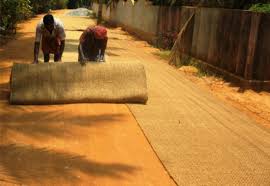
The Indian Road Congress (IRC) has accredited coir geotextiles as a new material for the construction and reinforcement of roads since 2011 and has published IRC Code book IRC: SP:129 – 2022 on Guidelines for the Design and Construction of Roads using Coir Geotextiles.
India is now in a growing trend in urbanisation requiring urban facilities and amenities. Population strength of India is leading to a demand growth in transportation sector too. There is a tremendous improvement in construction of roads and highways in last decade due to higher budget inflow and newer technologies. It is also seen that some roads, especially in rural areas, do not last long because of loose and expansive soils underneath. These loose and expansive soil can be modified by using natural resources making the soil more durable along with increasing the strength of the soil. Eco-friendly geotextiles (woven mats or net like materials) are used to improve the strength of soil reinforcement and prevent soil erosion thereby enhancing the durability of the construction. This special material works as a separator and create a drainage layer enabling in reduction of sub-soil erosion, thereby reducing rutting in weak soils and extending the life period of the road. The lignin content of coco-coir is found more durable than other natural fibres offering good separation and drainage. This is user-friendly, cost effective and bio-degradable too. Many countries like Sri Lanka and Australia, those having adequate raw material (Coir) are now using coir mat in road construction.
Coir mats or nets are laid between the natural soil (subgrade) and the aggregate layers. Fibers are mixed directly into the soil to increase the CBR (California Bearing Ratio) value of the soil. This increases the strength and load-bearing capacity of the soil and surface pavement materials. The required pavement thickness is also reduced while adopting this technology. Apart from above, this mat also protects the soil from rain-induced soil loss. While coir geo-textile is used for separation, reinforcement and erosion control, coir fibre is used as a mix-in additive for soil stabilisation.
This technology is cost effective as it reduces overall construction cost particularly in rural areas. It is eco-friendly, sustainable and an alternative to synthetics. As it is resistant to rot and microbial attack, it is durable enough to enhance the life period of the pavement by reducing swelling and increasing the soil strength. The performance of soil subgrade and bituminous mix is improved by mixing coir fiber than other natural fibers being used earlier. Depending on the engineering requirement, the length of fiber, varying fiber content and the height of the application in subgrade layer is decided. It acts as a reinforcement material for bituminous mix.
The Indian Road Congress (IRC) has accredited coir geotextiles as a new material for the construction and reinforcement of roads since 2011 and has published IRC Code book IRC: SP:129 – 2022 on Guidelines for the Design and Construction of Roads using Coir Geotextiles. Coir geotextile has obtained BIS standard IS 15869:2020 from Bureau of Indian Standards. Coir Board, India is pursuing strongly for promotion of use of coir geotextiles in construction of roads in rural areas. The Ministry of Textiles, Government of India has released the Quality Control Order, 2022 and allowed for extensive use of coir Geotextile. The Research Design & Standards Organisation of Indian railway has released the guidelines for application of coir geotextile in Railway Embankments and for use as erosion control measure in slopy lands. National Highways Authority of India has also started use of coir geotextiles in southern states and in other projects as erosion control measure.
Geotextile made from coconut fiber is now actively used in road construction in rural areas under Pradhan Mantri Gram Sadak Yojana (PMGSY-III) programme. The future prospects for coir fiber in India is encouraging because of its technical benefits and promotion being made by the Government. India is the largest producer of coir globally and its abundancy in availability makes it economical and renewable alternative to synthetic. It provides economic opportunity to local coir farmers especially women engaged in producing coir. When compared with other natural fibers such as Banana jute and sisal, it is found that Coco fiber is the best among all. Being natural and biodegradable, coir does not have disposal or pollution related problem. Ongoing research is exploring various new applications of coco fiber in managing embankments and hill slopes. The current initiatives and the performances indicate that the coir fiber will have significant role in road development strategy in future.