 Indian Industry Plus A Pratisrutiplus Suppliment





|
Introduction
Industrial parks have emerged as a principal vehicle for accelerating the country’s industry and innovation agenda. Developed in partnership with state governments and the private sector, these parks are reinforcing India’s industrial base by promoting investment, progress-driven development, and economic ascendancy. They stimulate employment generation while also encouraging sustainable development. As the government increasingly adopts the role of facilitator rather than regulator, these parks are sculpting a globally competitive industrial economy in India.
Industrial Parks Empowering Competitive and Viable Growth
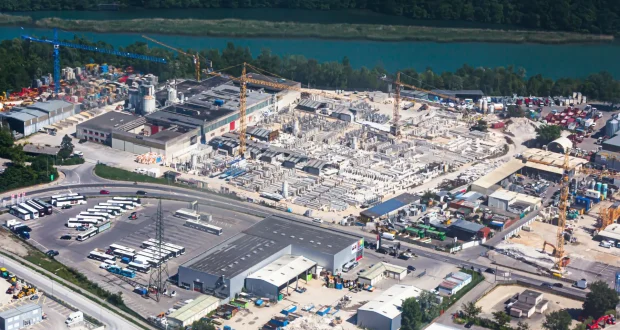
An industrial park refers to a planned tract of land that is subdivided and developed for industrial use, with or without ready-built factories, and supported by shared facilities for multiple industries. These parks form an essential institutional foundation and act as policy instruments that advance national economic development goals by increasing industrial output and strengthening the pace of economic progression.
Industrial Parks balance economic growth with environmental and social responsibility. Park management ensures adherence to environmental laws, spreads awareness on standards, and rewards companies that follow eco-friendly practices. They support resource efficiency by guiding firms on improved technologies and conducting audits to identify savings. Emissions are regularly monitored to control air, noise, and light pollution, while strict oversight prevents soil and groundwater contamination. Biodiversity protection is built into planning to safeguard ecosystem services, manage climate risks, and use land efficiently.
These parks also strengthen social well-being. They provide social infrastructure for employees and nearby communities, along with safe accommodation where necessary. Security systems protect workers and assets across the industrial area. Health and safety are promoted through medical checks, protective equipment, and monitoring of exposure levels. Gender-sensitive facilities and workplace inclusion ensure equitable participation. Openness to trade unions and civil society engagement helps improve labour conditions, transparency, and community trust.
Building Blocks of a Successful Industrial Park:
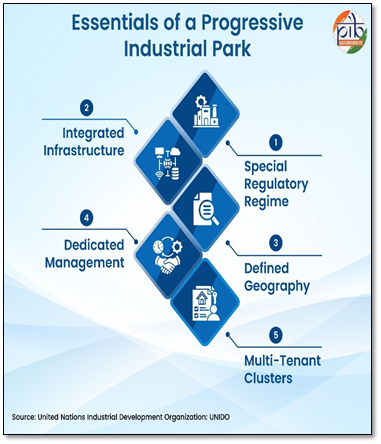
Special regulatory regime– Industrial parks operate under liberal and incentive-based rules for labour, land use, and foreign investment.
Integrated infrastructure– They offer shared hard and soft facilities such as utilities, telecom networks, waste systems, laboratories, internal roads, one-stop clearances, training centres, security, and emergency services.
Defined geography– Development takes place on clearly demarcated, master-planned land with uniform standards for buildings and facilities.
Dedicated management– A single authority oversees firm entry, ensures regulatory compliance, and drives long-term park development.
Multi-tenant clusters– Multiple firms operate within the park, collaborate, share resources, and enhance productivity through agglomeration and clustering effects.
Industrial Parks Fuelling EconomicEvolution:
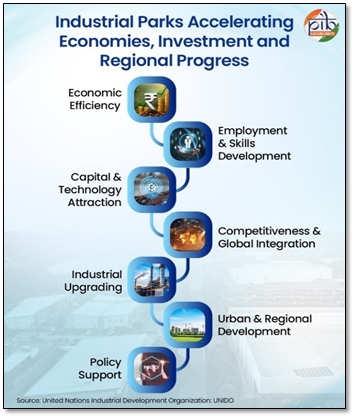
Economic efficiency – Industrial parks integrate scarce factors of production within defined geographic zones, generating higher productivity and operational efficiency.
Employment and skills development – They create jobs, improve wages, and strengthen the local talent base.
Capital and technology attraction – Parks draw investment and advanced technologies while enabling technology and managerial knowledge transfer.
Industrial upgrading and competitiveness – Clustered industrial activity stimulates upgrading, enhances national competitiveness, and deepens global value chain integration.
Policy incentives – Local, provincial, and national policies accelerate industrial growth and reinforce the gains generated by parks.
Urban and regional development – Industrial parks act as catalysts for economic expansion and sustainable progress in host cities and regions.
Planning and Establishment of Industrial Parks
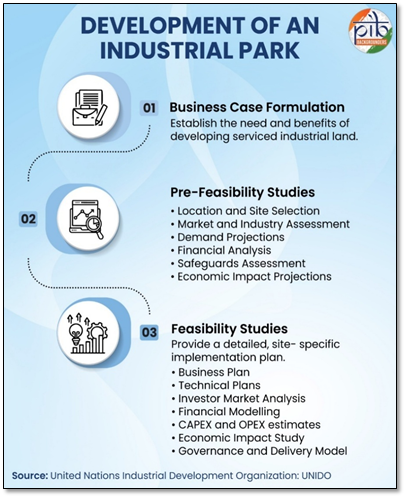
The incorporation of Industrial Parks is undertaken based on a business case that outlines the need for serviced industrial land and the anticipated economic and developmental benefits upon project completion. Following the preparation of the business case, pre-feasibility studies are carried out to evaluate potential sites for establishing an Industrial Park. These studies assess market suitability, connectivity to transport networks, availability of power and water, and overall cost viability. They also identify the sectoral opportunities likely to be attracted to the proposed park through an analysis of sector competitiveness, estimates of investment and industrial land demand, infrastructure and service requirements, and the expected scale of project costs and revenues. Subsequent assessments include financial analysis, policy analysis and stakeholder mapping, safeguards review, and economic impact projections. A final decision to establish and finance an Industrial Park is taken only after a comprehensive, site-specific feasibility study is completed, with conclusions that clearly support project viability.
Government Initiatives Revitalizing the Industrial Parks’ Ecosystem
Several initiatives and platforms are shaping India’s industrial parks’ growth and streamlining land access, accelerating industrial development, and supporting investor decision-making.
Plug-And-Play Industrial Parks
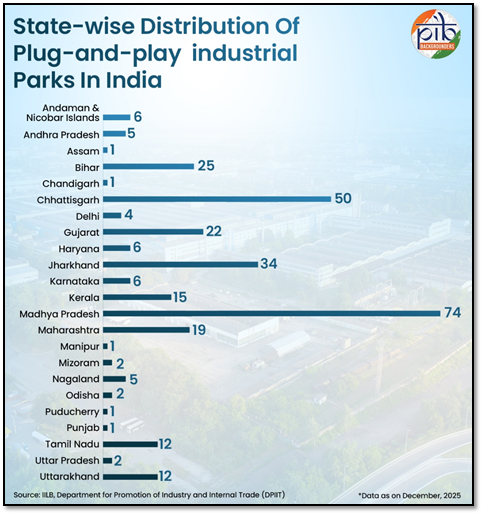
In the Union Budget 2025-26, Rs. 2,500 crores have been allocated for the development ofplug-and-play industrial parks. By providing infrastructure that is precision-designed to industry needs, the plug-and-play parks enhance operational efficiency and sustainability.
There are currently 306 plug-and-play industrial parks in India, and an additional 20 plug-and-play industrial parks and smart cities are being developed under the National Industrial Corridor Development Corporation (NICDC). Four projects have been completed, four are currently under construction, while the rest are advancing through different phases of bidding and tendering.
India Industrial Land Bank (IILB):
The Department for Promotion of Industry and Internal Trade (DPIIT) developed the India Industrial Land Bank (IILB), a centralized Geographic Information System (GIS)–enabled platformthat offers up-to-date, spatial and non-spatial information on industrial land across the country.
Formerly known as the Industrial Information System, the IILB serves as a one-stop repository for 4,523 industrial parks, mapped across a total area of approximately 7.70 lakh hectares. Of this, nearly 1.35 lakh hectares of land is currently available for industrial development. These parks collectively comprise more than 6.45 lakh plots, with over 1.25 lakh plots currently vacant (as on 23rd December, 2025), presenting significant opportunities for new investments in manufacturing, logistics, and allied sectors.
Overview of Industrial Parks and Associated Land Area Across Indian States and UTs (as on 23rd December, 2025):
| State | No. of Industrial Parks | Total Land Area (Hectares) | Land Available (Hectares) |
| Andaman & Nicobar | 6 | 35 | 8 |
| Andhra Pradesh | 638 | 110595 | 10747 |
| Arunachal Pradesh | 18 | 741 | 248 |
| Assam | 56 | 43497 | 486 |
| Bihar | 82 | 4139 | 649 |
| Chandigarh | 7 | 352 | 32 |
| Chhattisgarh | 114 | 22972 | 2574 |
| Dadra & Nagar Haveli | 5 | 119 | 50 |
| Daman & Diu | 5 | 57 | 0 |
| Delhi | 68 | 7017 | 976 |
| Goa | 22 | 1699 | 102 |
| Gujarat | 285 | 193975 | 12605 |
| Haryana | 51 | 9597 | 11661 |
| Himachal Pradesh | 64 | 960 | 185 |
| Jammu & Kashmir | 137 | 2841 | 264 |
| Jharkhand | 158 | 8194 | 1734 |
| Karnataka | 384 | 35910 | 3568 |
| Kerala | 140 | 6658 | 1292 |
| Ladakh UT | 8 | 33 | 2 |
| Lakshadweep | 9 | 2 | 1 |
| Madhya Pradesh | 144 | 23217 | 2916 |
| Maharashtra | 523 | 81308 | 19658 |
| Manipur | 7 | 36 | 13 |
| Meghalaya | 9 | 235 | 5 |
| Mizoram | 8 | 381 | 240 |
| Nagaland | 6 | 282 | 19 |
| Odisha | 146 | 72600 | 2744 |
| Puducherry | 11 | 658 | 0 |
| Punjab | 100 | 6331 | 2008 |
| Rajasthan | 420 | 33578 | 11655 |
| Sikkim | 5 | 20 | 3 |
| Tamil Nadu | 372 | 30772 | 16291 |
| Telangana | 157 | 32033 | 30749 |
| Tripura | 20 | 1828 | 623 |
| Uttar Pradesh | 286 | 33327 | 1320 |
| Uttarakhand | 35 | 3814 | 332 |
| West Bengal | 17 | 490 | 61 |
| Grand Total | 4523 | 770303 | 135821 |
Source: India Industrial Land Bank (IILB), Department for Promotion of Industry and Internal Trade, Ministry of Commerce and Industry, Government of India
Industrial Park Rating System (IPRS):
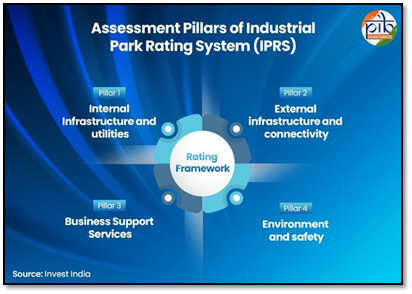
The Industrial Park Rating System (IPRS) is a comprehensive framework for assessing the performance and quality of industrial parks and business districts in India. Built on four assessment pillars, it provides valuable insights to investors, developers, and policymakers while encouraging park authorities to improve services and infrastructure. By promoting continuous improvement, the IPRS drives innovation, efficiency, sustainability, and ease of doing business. Its feedback reports serve as actionable roadmaps for infrastructure upgrades and service enhancement, while its collaborative approach promotes knowledge sharing and sector-wide growth beyond conventional rankings.
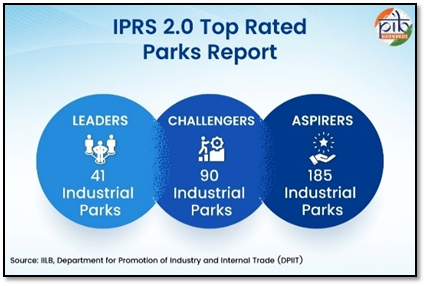
According to the IPRS 2.0 Top Rated Parks Report, a total of 41 industrial parks have been classified under the ‘Leaders’ category, representing high-performing parks with strong infrastructure, resilient industrial activity, and a well-established mix of sector-specific and multi-sector facilities. Further, 90 industrial parks have been identified as ‘Challengers’, representing parks that have shown substantial growth momentum. These parks display improving infrastructure and operational performance and are well-positioned to advance into the top tier with focused development initiatives. In addition, 185 industrial parks have been recognised as ‘Aspirers’, indicating parks that hold significant potential for future development. These parks are in earlier stages of growth and stand to benefit from targeted support to strengthen their infrastructure, services, and operational maturity. These rankings, based on key performance indicators, provide investors with transparent insights, promote healthy competition among States and Union Territories, and support evidence-based policymaking.
In September 2025, the Industrial Park Rating System (IPRS) 3.0 was launched to further strengthen India’s industrial ecosystem and enhance the competitiveness of its infrastructure. Building on the pilot phase (2018) and IPRS 2.0 (2021), this edition features an expanded framework with new parameters such as sustainability, green infrastructure, logistics connectivity, digitalization, skill linkages, and tenant feedback.
Ease of Doing Business Reforms:
India has strengthened the ease of doing business by supporting domestic and international investors, with industrial parks becoming central to attracting investment and meeting large-scale employment needs, as improved internal infrastructure has raised occupancy rates and stimulated economic growth.
Investors can remotely evaluate suitable land parcels using detailed information on infrastructure, connectivity, business support services, and environmental and safety standards, thereby enabling well-informed investment decisions.
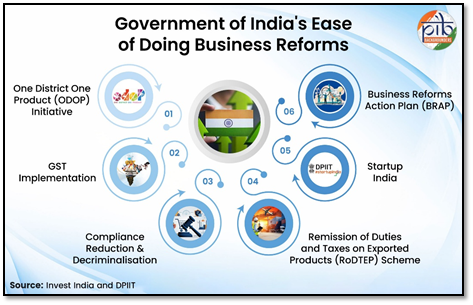
- National Business Reforms Action Plan (BRAP), 2014 – Accelerated improvements across key reform areas, including Information Wizard, Single Window Systems, Online Building Permission System, Inspection Reforms, and Labour Reforms.
- One District One Product (ODOP) initiative – Promoted district-specific products and strengthened local enterprises across the country.
- Goods and Services Tax (GST) – Unified multiple indirect taxes, such as excise duty and service tax, into a streamlined and transparent national tax framework.
- Startup India – Under the Startup India initiative, eligible companies can obtain DPIIT recognition to access a host of benefits, including tax incentives, simplified compliance, and fast-tracking of Intellectual Property Rights (IPR)-related processes.
- Remission of Duties and Taxes on Exported Products (RoDTEP) scheme – Encouraged entrepreneurship and enhanced the attractiveness and competitiveness of Indian exports.
- Compliance and legal burden reduction – Decriminalised 3,700 legal provisions and reduced more than 42,000 compliances to build a predictable, transparent, and business-friendly regulatory landscape.
Industrial Parks as Engines of FDI
India ranks among the world’s top 5 destinations for international project finance deals and Greenfield Project Investments, according to the United Nations Conference on Trade and Development (UNCTAD) 2025 World Investment Report. Foreign Direct Investment (FDI) inflows have continued on a mounting trajectory. During the April-August 2025-26, total FDI inflows reached USD 43.76 billion (provisional), compared with USD 37.03 billion in the corresponding period of FY 2024-25.
Industrial parks play a critical role in stimulating a country’s economic development by attracting FDIs and domestic capital, enhancing industrial performance, strengthening value chains, and expanding employment opportunities. They also support export-led growth and improve enterprise capabilities by enabling knowledge exchange and technology diffusion.
Enhanced FDI strengthens the development of industrial parks that align with national strategies. Supported by comprehensive feasibility studies and enabling policies, these platforms are significantly enhancing the investment environment, deepening regional value chains, and attracting higher levels of foreign capital.
Conclusion
India’s evolving industrial policy landscapeembodies a decisive transition towards industrial promotion, with industrial parksplaced at the forefront of this evolution. Their planned design, shared infrastructure, and coordinated governance structure create afacilitating environment that strengthens productivity, technology transfer, and employment generation.
To reinforce this accelerating trajectory, the Government of India has prioritised the development ofplug-and-play industrial parks, enhanced digital land access systems through the India Industrial Land Bank (IILB), and institutionalisedquality benchmarksthrough the Industrial Park Rating System (IPRS), affirming a sustained commitment toindustrial excellence. Complemented by wide-ranging ease of doing business reforms and a predictable regulatory climate, these initiatives have significantly motivated investor confidence and expanded opportunities for domestic and foreign investment.
As India’s industrial parks increasingly align withglobal best practices andsustainability standards, they are expected to fortifyregional value chains and integrate India more competitively into global manufacturing networks. At the same time, the Government recognises that the global industrial landscape is evolving with intensifying competition for FDI, and a worldwide shift toward a circular and green economy. Remaining relevant in this environment, India’s industrial parks are continuously upgrading their infrastructure, services, and market offerings.
Through these concerted measures, the Government of India is carving an industrial ecosystem that is inclusiveand globally recognised. The Government remains firmly committed to ensuring that industrial parks evolve in step with international standards, advocate sustainability–driven growth, and emerge as enduring engines of industrial prowess and economic strength.